No products in the cart.

Luc Mabille
‘…this gentle and mysterious oscillation’
Saturday 28/03/2026 — Sunday 26/04/2026
Opening Sunday 29/03/2024 at 16.00,
in the presence of the artist




Luc Mabille, Belgian, born in 1955, is a painter, architect, teacher and retired Professor of the École Supérieure des Arts Saint Luc, Belgium, retired Head of Works of the Faculty of Architecture of the University of Liège, Belgium, He lives and works in Liège.
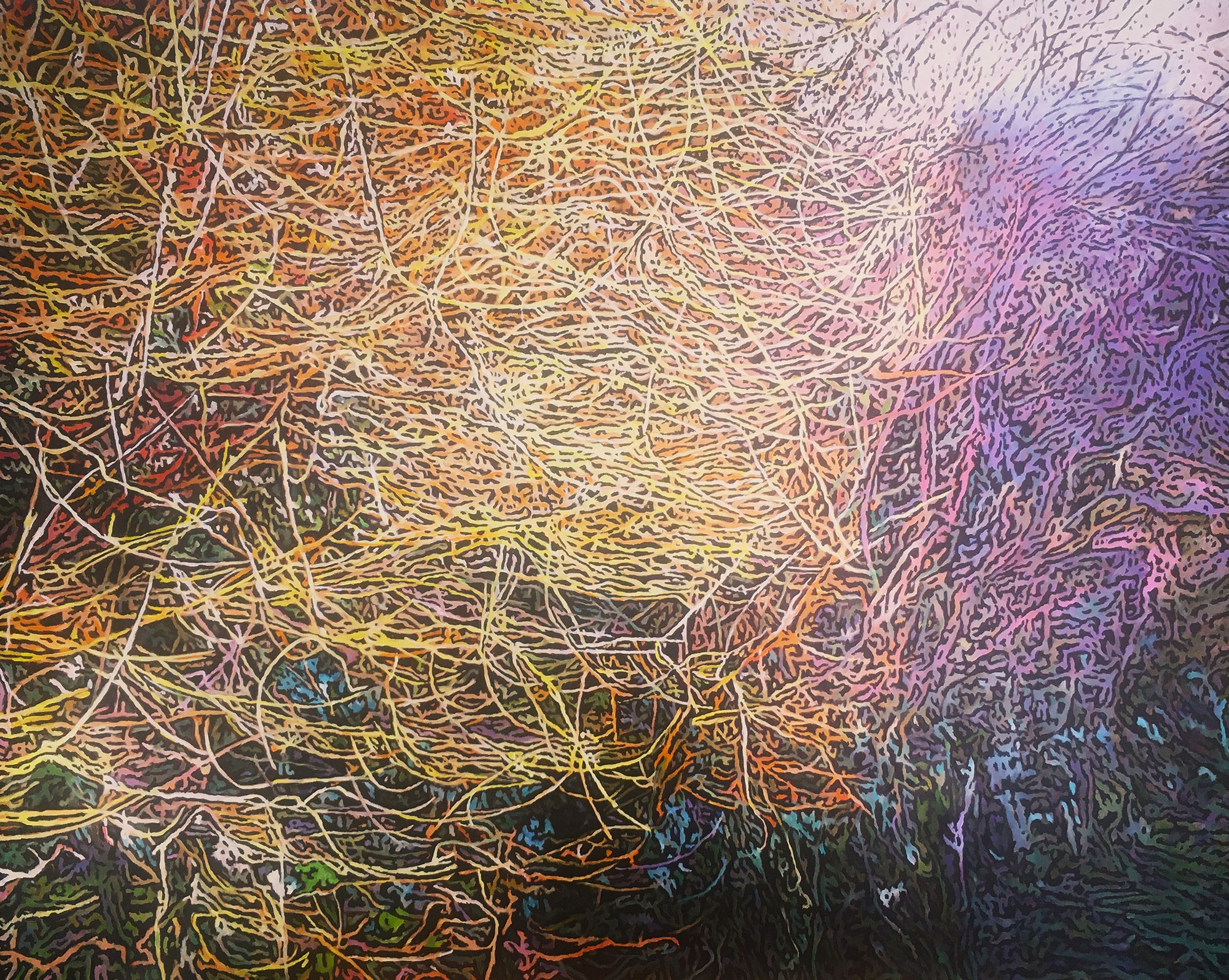
Luc Mabille deploys a painting that listens to nature rather than capturing it, he transposes into his canvases the intimate mechanics of the living: complexity of luminous interlacing where the plant composes a choreography that invades the pictorial field.
His scrutinizing gaze seeks not a fixed image, but the invisible force that runs through the vegetable kingdom – an oscillating energy where everything is vibration. In this quest for a hidden truth, the fierce resilience of nature does not close the dialogue with humans, it provokes them.
Mabille's works do not dramatize nature; they expose it in its stubborn resilience and in its assaults of luxuriance.
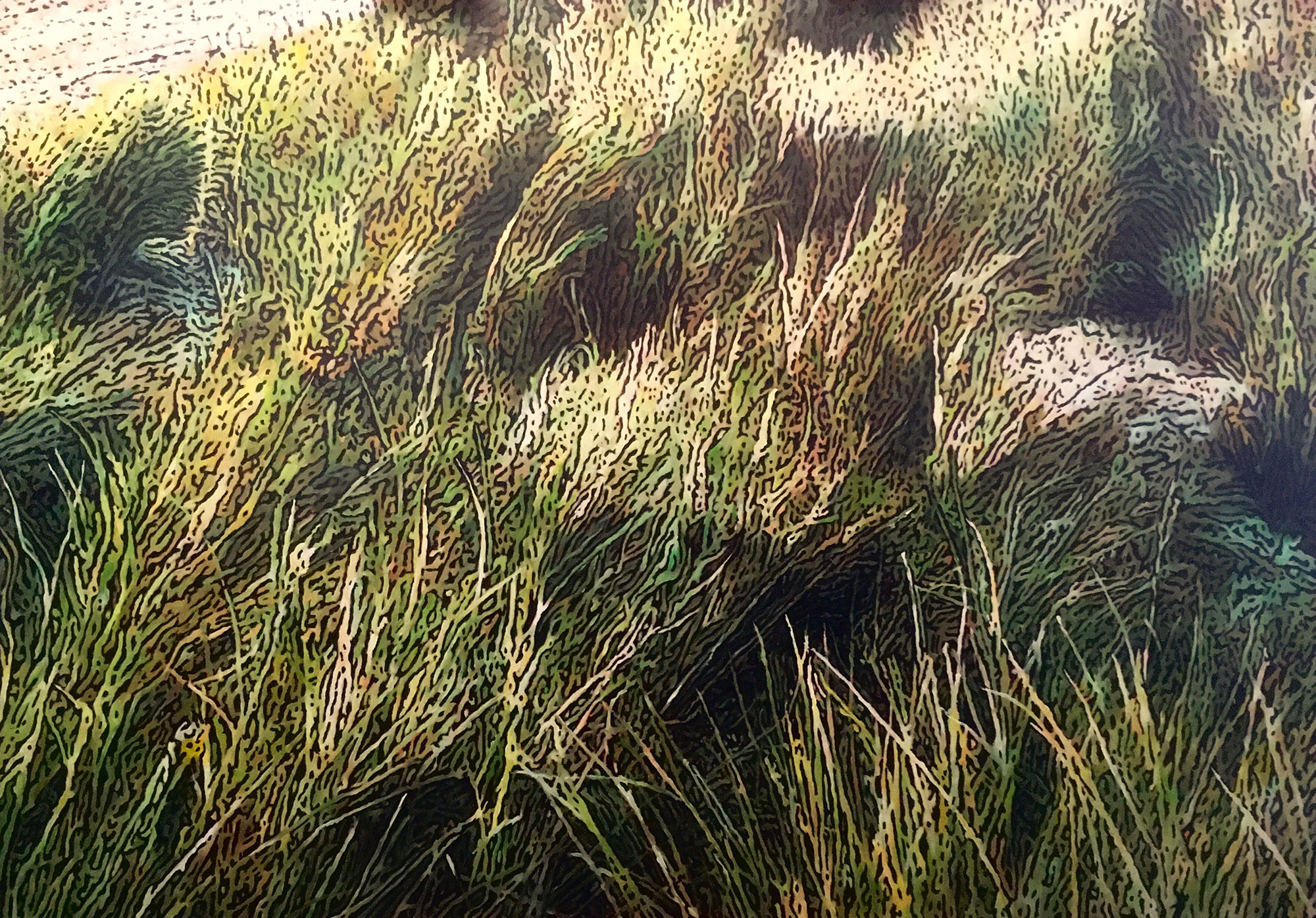
Through a patient practice, made up of thousands of tiny lines and a subtle luminous modelling, he organizes the ‘green chaos’ into palpable surfaces: the canvas becomes a place of immersion where we perceive the humus, where we think we hear the grass and the wood.
For example, in the series 'Dunes' he proposes a poetic ‘displacement’: transposed onto sand, the plant motifs become ‘mounds’ of thought – havens of reverie guided by imaginary winds. Or in the painting ‘The Conversation’ (homage to Lucas Cranach), an updated quote from a famous work in the history of art; (Adam and Eve; these opposite/complementary beings of the Garden of Eden) thus revisiting the canonical association, and metamorphosing the original couple into two trees with distant sensualities.
Displacement of the sacred to a new ‘place’, invites us to take a fresh look at a nature, sometimes rendered invisible but essential, in which an unalterable truth resides.
This nature is as present as it eludes us in Mabille’s work; our vision of it may become blurred and already appears to us only as a memory.
These paintings invite active contemplation: the viewer is no longer a simple observer, but a partner in a continuous exchange between humans and the natural world.
A visual poetry that invites the viewer to let themselves be captivated.
Luc Mabille, Belg, geboren in 1955, is kunstschilder, architect, docent en gepensioneerd professor aan de École Supérieure des Arts Saint Luc, België, en gepensioneerd chef de travaux van de Faculteit Architectuur van de Universiteit van Luik, België. Hij leeft en werkt in Luik.
Luc Mabille ontwikkelt een schilderkunst die eerder naar de natuur luistert dan haar probeert vast te grijpen. In zijn doeken vertaalt hij de intieme mechaniek van het levende: de complexiteit van lichtende verstrengelingen waarin het plantaardige een choreografie vormt die het picturale veld binnendringt. Zijn onderzoekende blik zoekt geen stilstaand beeld, maar de onzichtbare kracht die door het plantenrijk stroomt – een oscillerende energie waarin alles trilling is. In deze zoektocht naar een verborgen waarheid sluit de onverzettelijke veerkracht van de natuur de dialoog met de mens niet af, maar lokt ze die juist uit.
De werken van Mabille dramatiseren de natuur niet; ze tonen haar in haar hardnekkige veerkracht en in haar uitbarstingen van weelderigheid.
Door een geduldige werkwijze, opgebouwd uit duizenden minuscule lijnen en een subtiele lichtmodellering, ordent hij de ‘groene chaos’ tot tastbare oppervlakken: het doek wordt een plaats van onderdompeling waar men de humus bijna kan voelen en waar men het gras en het hout meent te horen.
Bijvoorbeeld in de reeks ‘Dunes’ stelt hij een poëtische ‘verplaatsing’ voor: overgebracht op zand worden de plantaardige motieven ‘heuveltjes’ van gedachten – toevluchtsoorden voor dagdromen, geleid door denkbeeldige winden. Of in het schilderij ‘The Conversation’ (een hommage aan Lucas Cranach the Elder), een geactualiseerde verwijzing naar een beroemd werk uit de kunstgeschiedenis (Adam en Eve, de tegengestelde maar complementaire wezens uit de Garden of Eden) herneemt hij deze canonieke associatie en transformeert hij het oorspronkelijke koppel tot twee bomen met een sensuele maar afstandelijke aanwezigheid.
De verplaatsing van het sacrale naar een nieuwe ‘plaats’ nodigt uit om met een frisse blik te kijken naar een natuur die soms onzichtbaar wordt gemaakt, maar essentieel blijft en waarin een onveranderlijke waarheid schuilt. Bij Mabille is deze natuur zowel aanwezig als ongrijpbaar; onze blik erop kan vertroebelen, zodat zij ons soms al slechts als een herinnering verschijnt.
Deze doeken nodigen uit tot een actieve contemplatie: de toeschouwer is niet langer een eenvoudige observator, maar een partner in een voortdurende uitwisseling tussen de mens en de natuurlijke wereld. Een visuele poëzie die de toeschouwer uitnodigt zich te laten meevoeren en raken.
Luc Mabille, Belge, né en 1955, est artiste peintre , architecte, enseignant et Professeur retraité de l’École Supérieure des Arts Saint Luc, Belgique, Chef de Travaux retraité de la Faculté d’Architecture de l’université de Liège, Belgique, Il vit et travaille à Liège.
Luc Mabille déploie une peinture qui écoute la nature plutôt que de la saisir, il transpose dans ses toiles la mécanique intime du vivant: complexité des entrelacs lumineux ou le végétal compose une chorégraphie qui envahit le champ pictural.
Son regard scrutateur cherche non une image fixe, mais la force invisible qui traverse le règne végétal – une énergie oscillante où tout est vibration. Dans cette quête d’une vérité cachée, la résilience farouche de la nature ne ferme pas le dialogue avec l’humain, elle le provoque.
Les œuvres de Mabille ne dramatisent pas la nature; elles l’exposent dans sa résilience obstinée et dans ses assauts de luxuriance.
Par une pratique patiente, faite de milliers de traits minuscules et d’un modelé lumineux subtil, il organise le ‘chaos vert’ en surfaces palpables: la toile devient lieu d’immersion où l’on perçoit l’humus, où l’on croit entendre l’herbe et le bois.
Par exemple dans la série ‘Dunes’ il propose un ‘déplacement’ poétique: transposés sur sable, les motifs végétaux deviennent ‘monticules’ de pensée – havres de rêverie guidés par des vents imaginaires. Ou dans le tableau ‘The Conversation’ (hommage à Lucas Cranach), citation réactualisée d’une œuvre célèbre de l’histoire de l’art; (Adam et Ève; ces êtres opposés/complémentaires du jardin d’Eden) revisitant ainsi l’association canonique, et métamorphosant le couple originel en deux arbres aux sensualités distantes.
Déplacement du sacré vers un nouveau ‘lieu’, invite à poser un regard neuf sur une nature, parfois invisibilisée mais essentielle, dans laquelle réside une inaltérable vérité.
Cette nature chez Mabille est autant présente qu’elle nous échappe; la vision que nous avons d’elle peut se brouiller, et déjà ne nous apparait plus que comme un souvenir.
Ces toiles invitent à une contemplation active: le spectateur n’est plus simple observateur, mais partenaire d’un échange continu entre l’humain et le monde naturel.
Une poésie visuelle qui invite le spectateur à se laisser saisir.